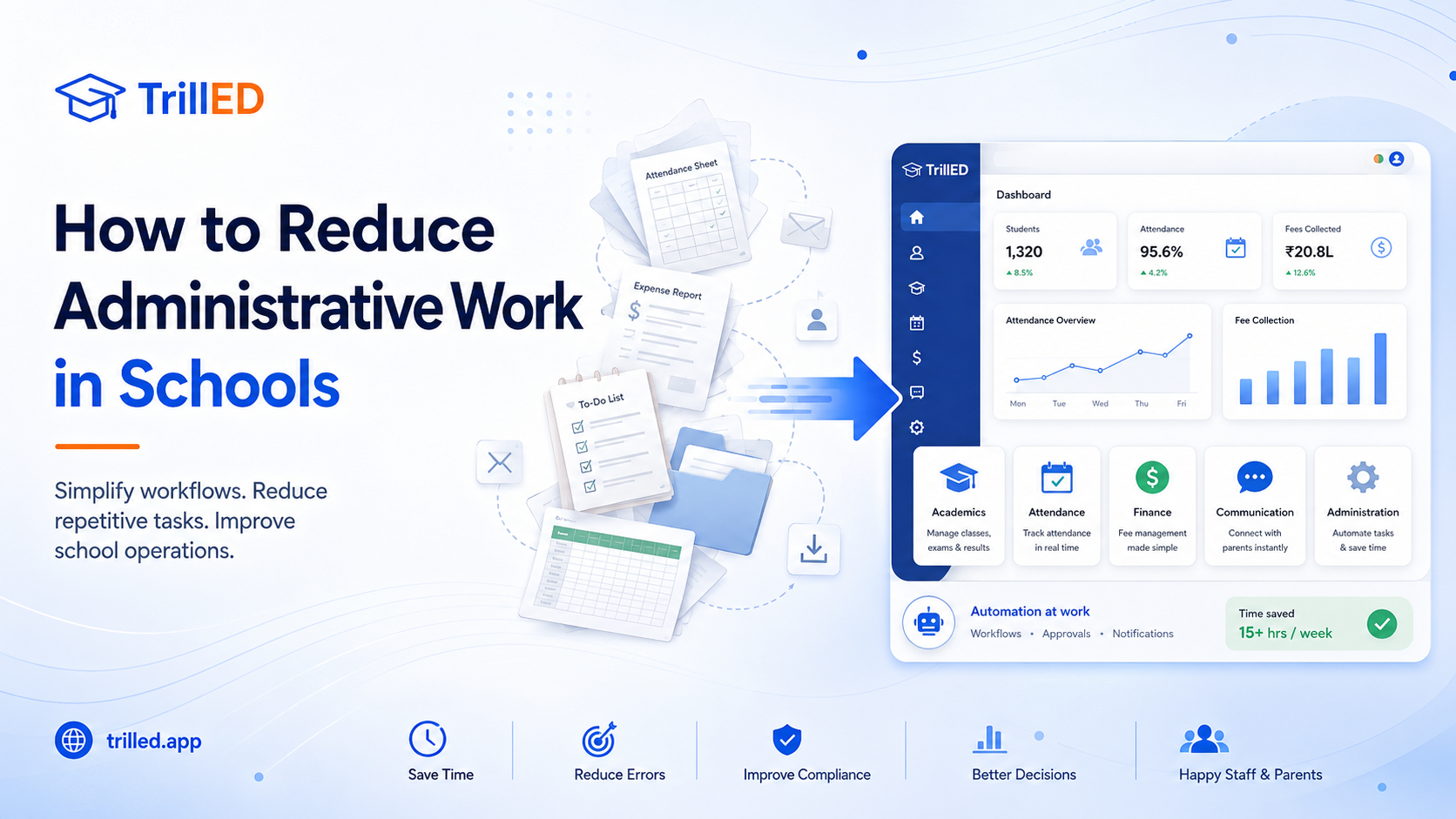
School administration is necessary, but it should not consume the majority of the time available to teachers, administrators, finance teams, and school leaders.
Yet in many schools, everyday operations still depend on spreadsheets, paper forms, repeated data entry, manual calculations, separate messaging applications, and information being passed from one department to another.
A teacher records attendance. Someone else compiles it into a report.
The finance office records a payment. Another staff member updates a spreadsheet.
Student information changes. The same change may need to be entered into several different records.
Management wants a report. Administrators spend hours collecting information from different departments before the report can be prepared.
Individually, these tasks may seem small. Together, they create a significant administrative burden.
Reducing administrative work does not mean removing important controls or responsibilities. It means designing school operations so that staff spend less time moving information around and more time using that information to make decisions and support students.
Here are practical ways schools can achieve that.
1. Identify Where Administrative Time Is Actually Going
Before introducing new technology or changing processes, schools should understand where administrative work is being created.
Some of the biggest sources are often repetitive activities such as:
-
Entering the same student information into multiple systems
-
Preparing attendance summaries manually
-
Calculating and following up outstanding school fees
-
Preparing examination results and report cards
-
Communicating the same information to parents individually
-
Producing routine management reports
-
Updating staff and student records
-
Managing paper-based approvals
-
Searching through spreadsheets for information
-
Reconciling records maintained by different departments
A useful question is:
How many times does the same information have to be entered, copied, checked, or communicated?
The more times information has to move manually between people or systems, the greater the administrative workload.
2. Create One Reliable Source of School Data
One of the biggest causes of unnecessary administrative work is fragmented information.
Consider a school where:
-
Admissions maintains student information in one spreadsheet
-
Teachers maintain class lists separately
-
Finance has another list for billing
-
Transport maintains its own student records
-
Examination data exists somewhere else
-
Parent contact details are stored in several places
When a student changes class, updates a phone number, leaves the school, or changes transport arrangements, several records may need to be updated manually.
This creates both additional work and the possibility of inconsistent data.
A more efficient approach is to maintain a central student record that other operational processes can use.
The same principle should apply to staff, guardians, classes, subjects, fee structures, and other important information.
When information is maintained once and used across connected workflows, administrative duplication can be significantly reduced.
3. Replace Repetitive Data Entry With Connected Workflows
Digitisation alone does not necessarily reduce administrative work.
A school can replace paper forms with digital forms and still have inefficient processes if employees must repeatedly copy information between systems.
The bigger opportunity comes from connected workflows.
For example, when a student is enrolled:
-
The student's record is created.
-
The student is assigned to a class.
-
The appropriate fee structure can be associated with the student.
-
Teachers can access the student through their class records.
-
Attendance becomes available for that student.
-
Examination and reporting workflows can use the same record.
-
Authorised guardians can be connected to the student.
The objective is to avoid treating every department as an isolated administrative environment.
A single action should update or become available to other relevant processes wherever possible.
4. Automate Attendance Management
Attendance is one of the most repetitive administrative processes in a school because it happens continuously.
In a manual environment, the process can involve:
-
Teachers taking attendance
-
Attendance sheets being collected
-
Records being entered into spreadsheets
-
Daily totals being calculated
-
Absence information being communicated
-
Weekly or monthly reports being prepared
Much of this work can be simplified through digital attendance management.
Teachers should be able to record attendance directly into the school's system, while administrators and authorised staff can view the information without waiting for someone to prepare another report.
Depending on a school's requirements, attendance can also be supported through technologies such as QR-based processes or other school-managed attendance tools.
The important principle is that attendance should become operational data at the moment it is recorded, rather than information that must later be re-entered and reorganised.
5. Simplify School Fee Administration
School fee management can create a considerable amount of administrative work.
Finance teams often have to answer questions such as:
-
Who has paid?
-
How much has each student paid?
-
Which invoices are overdue?
-
What balance remains?
-
Which fee structure applies to a student?
-
What was collected during a particular period?
-
Which payments require follow-up?
When these records are maintained manually, producing answers can require searching through receipts, spreadsheets, payment records, and student files.
A connected fee management system can help organise:
-
Student billing
-
Fee structures
-
Invoices
-
Payments
-
Outstanding balances
-
Collection history
-
Financial reports
Instead of repeatedly calculating the school's financial position, authorised staff should be able to retrieve the information from current operational records.
This allows finance employees to spend more time handling genuine exceptions and less time reconstructing information that should already be available.
6. Reduce Manual Report Preparation
Reports are essential, but schools should question how much time employees spend building reports that could be generated from existing data.
For example, management may routinely need information about:
-
Student attendance
-
Outstanding fees
-
Fee collections
-
Academic performance
-
Student population
-
Staff attendance
-
Enrolment
-
Class performance
-
Operational activities
When these reports require different departments to prepare spreadsheets every time management asks a question, the problem is usually not a lack of data.
The problem is that the data is difficult to access.
Dashboards and automatically generated reports can transform reporting from:
"Please prepare this information for me."
into:
"The current information is already available."
This is an important difference.
Good reporting systems do not simply make reports look better. They reduce the administrative work required to produce them.
7. Give Users Role-Based Access
Administrators often become unnecessary intermediaries because other users cannot access information themselves.
A parent asks about a student's result.
A teacher asks for a class list.
A staff member wants to check information about an assignment.
Management wants to know the current fee position.
Every request becomes another administrative task.
Role-based systems can reduce this burden by allowing different users to access the information appropriate to their responsibilities.
For example:
Teachers can access their classes, attendance, academic tools, and student information.
Finance staff can access billing, payments, outstanding balances, and relevant reports.
Parents can access appropriate information about their children.
School leaders can access management dashboards and institutional reports.
Administrators retain broader operational control.
The objective is not to give everyone access to everything.
It is to ensure that authorised users do not have to ask an administrator every time they need information they should already be permitted to see.
8. Centralise School Communication
Communication can quietly become another major administrative burden.
Schools may use a combination of:
-
WhatsApp
-
Telegram
-
SMS
-
Email
-
Printed notices
-
Phone calls
-
Parent groups
-
Teacher groups
Using different communication channels is not automatically a problem, but difficulties arise when important school communication has no connection to school records or workflows.
Administrators may repeatedly copy contact information, recreate recipient groups, and send similar messages manually.
A school management platform can help connect communication to existing groups such as:
-
Classes
-
Parents
-
Students
-
Teachers
-
Staff
-
Branches
This allows schools to communicate based on information already stored within the operational system.
For example, an administrator should not need to manually reconstruct a contact list every time a message needs to reach the parents of a particular class.
9. Standardise Common Administrative Processes
Automation works best when the underlying workflow is clear.
Schools should therefore identify processes that are frequently handled differently depending on who is performing them.
Examples might include:
-
Student admissions
-
Fee adjustments
-
Examination preparation
-
Report-card publication
-
Staff onboarding
-
Certificate generation
-
Inventory requests
-
Student transfers
-
Parent communication
A process that exists only in the memory of an experienced employee is difficult to scale.
Where possible, schools should define:
What starts the process?
Who is responsible?
What information is required?
Who needs access?
What approval is necessary?
What should happen next?
Once a workflow has been standardised, software can support or automate parts of it much more effectively.
10. Reduce Dependence on Spreadsheets for Operational Processes
Spreadsheets remain useful tools.
The problem begins when they become the primary operational infrastructure of the school.
A school may gradually accumulate files such as:
Students_Final.xlsx
Students_Final_New.xlsx
Students_Updated.xlsx
Fees_2026.xlsx
Fees_2026_Updated.xlsx
Attendance_July.xlsx
At that point, staff may spend considerable time determining which file contains the correct information.
Spreadsheets are especially difficult when several people need to work with connected information at the same time.
The objective should not necessarily be to eliminate every spreadsheet.
Instead, schools should avoid using spreadsheets as the primary database for processes that require:
-
Multiple users
-
Access controls
-
Continuous updates
-
Relationships between records
-
Historical tracking
-
Reporting
-
Automation
Those processes are generally better managed through a structured system.
11. Automate Routine Academic Administration
Academic administration also contains many opportunities for reducing repetitive work.
Teachers and administrators may spend considerable time managing:
-
Subject assignments
-
Examination scores
-
Grade calculations
-
Report cards
-
Homework
-
Student records
-
Timetables
-
Academic reports
When these processes are connected, information can move naturally through the academic workflow.
For example, examination scores recorded in a gradebook should be usable in academic reporting without requiring someone to copy them into another spreadsheet first.
The goal is simple:
Enter information where it originates and reuse it wherever it is legitimately required.
12. Introduce Self-Service Where Appropriate
Some administrative work exists only because every action requires an employee to intervene.
Schools can reduce this burden by providing controlled self-service options.
Depending on the institution, self-service may allow authorised users to:
-
View relevant student information
-
Access results
-
Check fee balances
-
View attendance
-
Access timetables
-
Receive school announcements
-
View homework
-
Download permitted documents
Self-service should not mean removing school oversight.
It means reducing unnecessary requests for information that can safely and securely be made available directly.
13. Manage Exceptions Instead of Every Transaction
This is one of the most important principles of administrative automation.
Traditional administration often requires employees to process every transaction manually.
A better system allows routine operations to happen normally while drawing attention to situations that require human intervention.
For example, staff may need to focus on:
-
Overdue fees rather than every payment
-
Unusual attendance patterns rather than every attendance record
-
Missing examination scores rather than every completed score
-
Pending approvals rather than every completed workflow
-
Operational exceptions rather than normal activity
This changes the administrator's role from constantly processing information to supervising operations and resolving exceptions.
That is where technology can create meaningful operational improvement.
14. Avoid Creating Too Many Separate Systems
Schools sometimes attempt to solve administrative problems by purchasing a separate application for each one.
They may eventually have:
-
One attendance system
-
One finance application
-
Another system for academics
-
Another parent application
-
Separate transport software
-
Another tool for communication
Each application may work well individually.
However, the institution can end up replacing spreadsheet fragmentation with software fragmentation.
Administrators are then required to maintain integrations, duplicate records, remember multiple logins, reconcile conflicting data, and move information between platforms.
Before adding another application, schools should ask:
Can this workflow be handled within our existing operational platform?
The fewer unnecessary boundaries between systems, the easier school operations generally become.
15. Choose Technology Around Workflows, Not Feature Counts
A long feature list does not automatically reduce administrative work.
A school system could contain dozens of modules and still create unnecessary complexity if those modules do not work together.
When evaluating school management software, examine actual workflows.
Ask questions such as:
-
What happens when a new student is enrolled?
-
How is that student connected to billing?
-
How does attendance information reach management?
-
How are results converted into reports?
-
How are parents connected to students?
-
How are staff permissions controlled?
-
How quickly can management see operational information?
-
How many times does the same information need to be entered?
The quality of these workflows matters more than the number of items on a feature page.
Administrative Efficiency Is Ultimately About Connection
Reducing administrative work is not simply about asking staff to work faster.
It is about designing operations so that unnecessary work does not need to happen in the first place.
The biggest improvements often come from:
Centralising important data.
Connecting related workflows.
Automating repetitive processes.
Giving authorised users appropriate self-service access.
Generating reports directly from operational data.
Reducing duplicate data entry.
Allowing administrators to focus on exceptions rather than routine transactions.
When these improvements work together, a school can operate with greater clarity without continuously increasing its administrative workload as the institution grows.
How TrillED Helps Reduce Administrative Work
TrillED is designed around this connected approach to school operations.
Instead of requiring schools to manage academics, attendance, finance, communication, administration, staff operations, transport, and reporting through disconnected tools, TrillED brings these workflows into one operational environment.
The platform includes capabilities for areas such as:
-
Student and guardian management
-
Academics and class operations
-
Attendance
-
Examinations and gradebooks
-
School fees and financial tracking
-
Staff operations
-
Parent and school communication
-
Transport operations
-
Inventory and library management
-
Certificates and identification
-
Multi-branch management
-
Operational reporting and dashboards
Different users can access the areas relevant to their responsibilities, while school leaders gain broader visibility across institutional operations.
The objective is not simply to digitise existing paperwork.
It is to help schools build a more connected operating model in which information can move through the institution without repeatedly being recreated, transferred, and reconciled manually.
Final Thoughts
Administrative work will always be part of running a school.
Admissions must be managed. Attendance must be recorded. Fees must be tracked. Parents must be informed. Academic records must be maintained. Management needs accurate information.
The opportunity lies in changing how much human effort is required to perform those responsibilities.
Schools that centralise data, connect workflows, automate repetitive activities, and provide appropriate self-service access can reduce unnecessary administration without sacrificing oversight.
And as a school grows, this becomes increasingly important.
The goal should not be to make administrators work faster at repetitive tasks.
The goal should be to remove as many unnecessary repetitive tasks as possible — so staff can focus on the work that genuinely requires people.