Overview: From fragmented systems to faster school operations
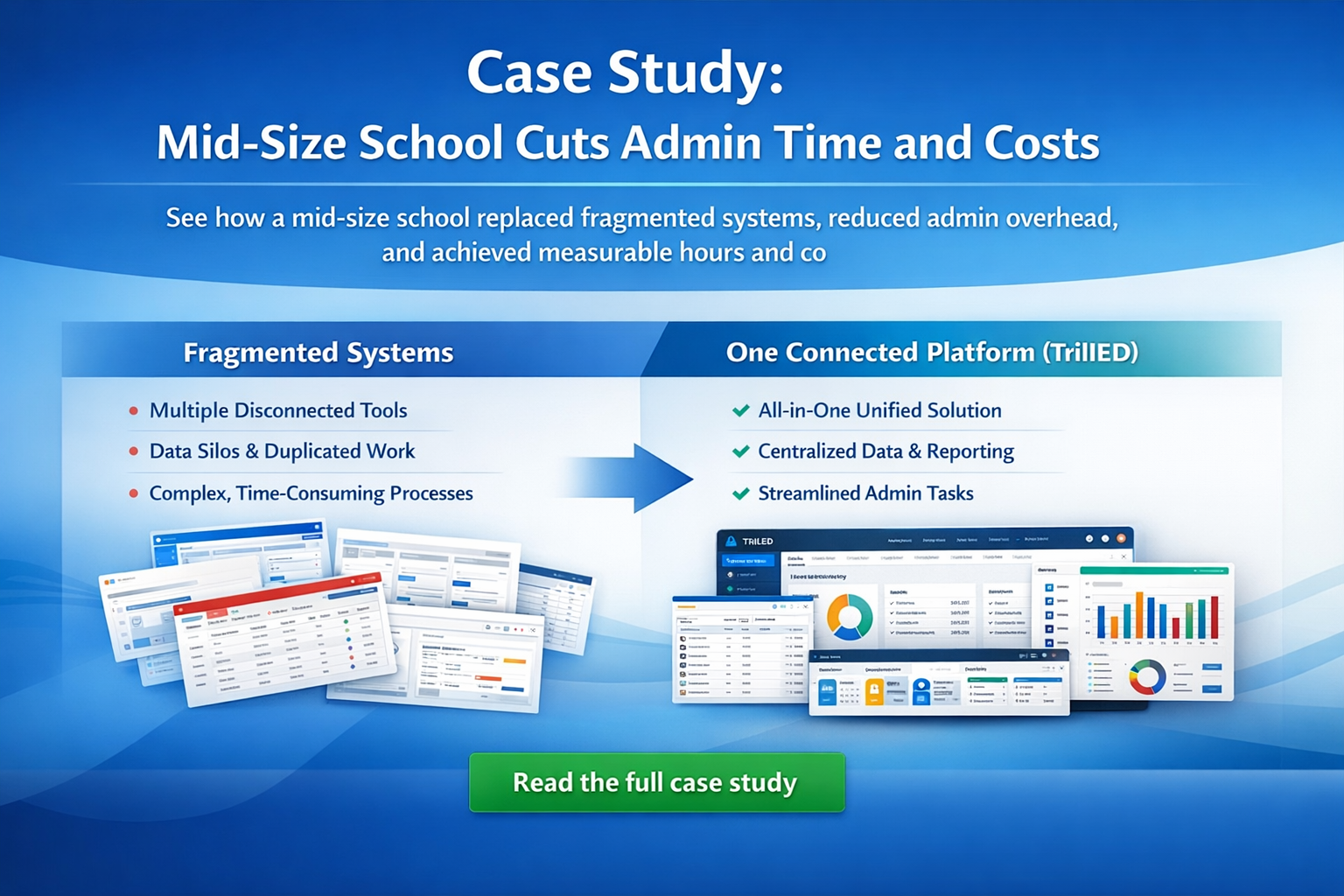
A mid-size school’s operations team was spending too much time on manual, repetitive administration across multiple tools. The leadership team needed a practical way to reduce workload, improve visibility, and control costs without disrupting teaching and learning.
This case study outlines the school’s baseline fragmented systems and high admin overhead, the implementation phased rollout of core modules, and the outcome measurable hours and cost savings in 6 months.
The baseline: fragmented systems and high admin overhead
Before adopting a unified school-management platform, the school relied on a mix of spreadsheets, point solutions, and manual processes. Information was duplicated across systems, and teams spent significant time reconciling discrepancies.
Common challenges included:
- Multiple sources of truth: Student, attendance, billing, and communications data lived in separate tools.
- Manual handoffs: Admin tasks required exporting, cleaning, and re-uploading data between systems.
- Limited reporting: Leaders lacked timely, reliable visibility into operational performance.
- High admin overhead: Staff time was consumed by repetitive tasks rather than student- and family-facing work.
Implementation: phased rollout of core modules
The school chose a phased approach to reduce risk and ensure teams could adopt new workflows without overwhelming day-to-day operations.
Phase 1: Stabilize the fundamentals
The first phase focused on core records and day-to-day processes, with clear ownership and simple success criteria.
- Data consolidation: Standardized student and family records and cleaned duplicates.
- Role-based access: Ensured staff had the right permissions without adding complexity.
- Process mapping: Documented “current vs. future” workflows for high-volume admin tasks.
Phase 2: Replace manual admin with integrated workflows
Once core records were stable, the school rolled out modules that directly reduced repetitive work and improved coordination across teams.
- Attendance and daily operations: Reduced double-entry and streamlined follow-ups.
- Parent communications: Centralized messaging and reduced time spent searching for context.
- Billing or fee workflows (where applicable): Improved tracking and reduced back-and-forth between teams.
Phase 3: Reporting and leadership visibility
The final phase focused on making performance measurable and easy to review, enabling leaders to spot issues early and plan resourcing with confidence.
- Standard reports: Created consistent reporting for key operational areas.
- Exception handling: Highlighted incomplete records and overdue actions for quick resolution.
Outcome: measurable hours and cost savings in 6 months
Within six months, the school reported measurable improvements in both time and cost. By reducing duplicate entry, consolidating tools, and standardizing workflows, the operations team reclaimed time for higher-value work and improved service quality for staff and families.
Key outcomes included:
- Measurable hours saved: Less time spent on data reconciliation, reporting, and manual follow-ups.
- Reduced operational friction: Fewer handoffs and fewer “where is the latest version?” issues.
- Cost savings: Consolidation helped reduce spend on overlapping tools and ad hoc fixes.
- Faster decision-making: Leadership gained more reliable visibility into operational status and workload.
What school leaders can replicate
For schools facing similar challenges, these practices made the difference:
- Start with a clear baseline: Document where admin time is going and which systems create duplication.
- Use a phased rollout: Stabilize core records first, then expand to workflows and reporting.
- Assign owners per process: Ensure each workflow has a responsible lead to drive adoption and consistency.
- Measure outcomes early: Track hours saved and tool consolidation to demonstrate progress within months.
CTA: Want to see what a phased rollout of core modules could look like for your school? Request a walkthrough to map your current workflows, identify quick wins, and build a 6-month plan to reduce admin overhead and costs.