Cut admin time by connecting admissions and fee collection
When admissions, billing, and finance run on separate tools (or spreadsheets), teams spend hours re-entering data, chasing missing documents, and reconciling payments. A unified school-management platform streamlines the full journey—from enquiry to enrollment to fee payment—so your team can focus on students, not paperwork.
By standardizing processes and reducing manual handoffs, schools can improve speed, accuracy, and visibility across the academic year.
Automate admissions workflows to reduce data entry
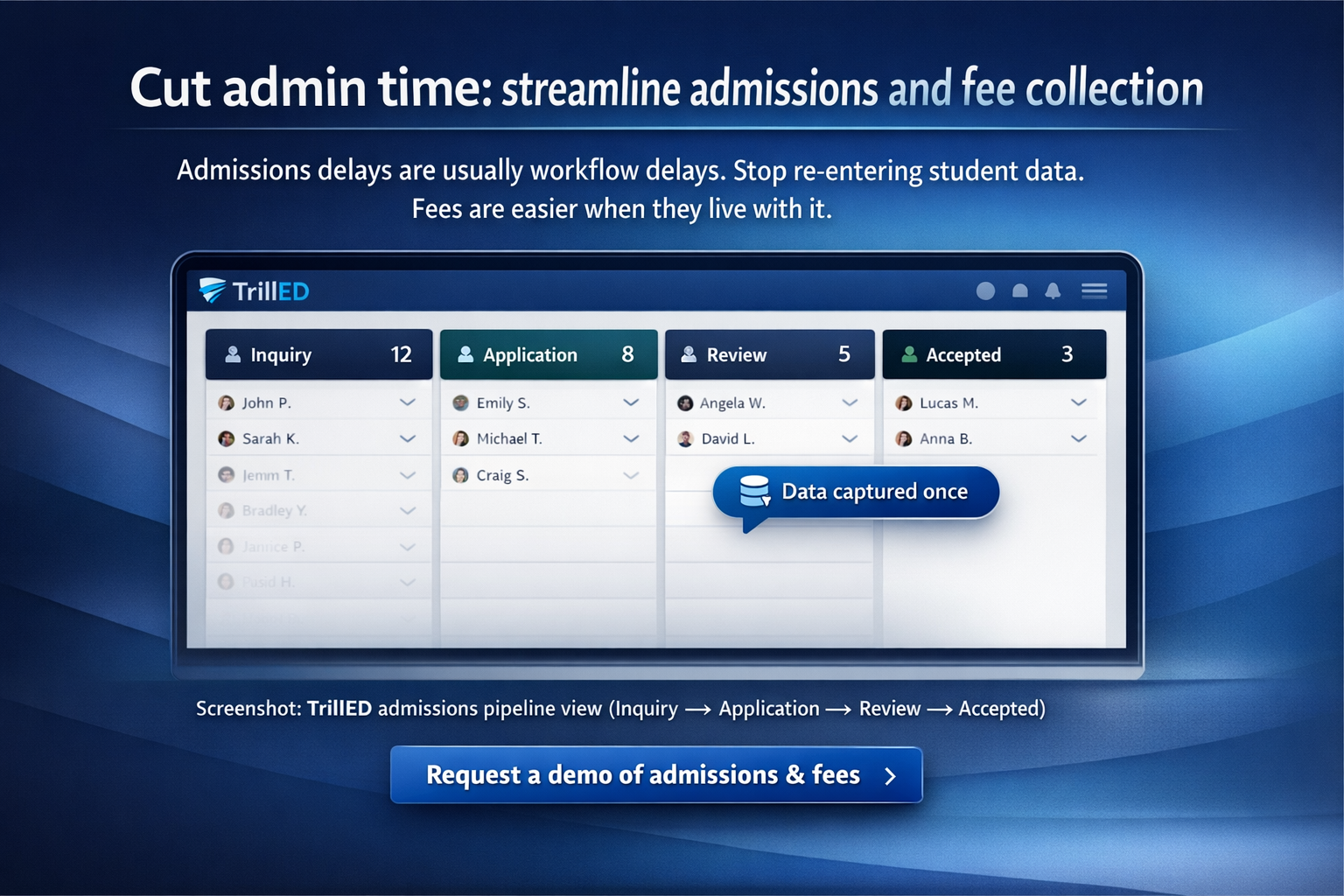
Automated admissions workflows reduce data entry by capturing information once and reusing it across forms, records, and communications. Instead of duplicating student details across multiple systems, teams can rely on structured steps that move applicants forward automatically.
- Online application forms: Collect consistent data from families, including required fields and validations to reduce back-and-forth.
- Document checklists: Track what’s submitted (ID, transcripts, immunization records) and what’s outstanding at a glance.
- Status stages and triggers: Automatically advance applications when prerequisites are met (e.g., payment received, documents verified).
- Role-based access: Admissions, finance, and leadership see the same record without emailing spreadsheets.
Result: fewer errors, faster processing, and less time spent fixing incomplete or inconsistent student records.
Integrate fee collection to lower missed payments
Integrated fee collection lowers missed payments by linking invoices, due dates, and payment status to each student record. This eliminates manual reconciliation and makes it easy to see who has paid, what is overdue, and what follow-up is needed.
- Auto-generated invoices: Create fees based on grade, program, transport, meals, or one-time charges.
- Multiple payment methods: Support bank transfer, card, mobile money, or other options relevant to your community.
- Automated reminders: Send due and overdue notifications without staff manually drafting messages.
- Real-time payment updates: Reduce calls and emails by letting families see balances and receipts.
With admissions and finance connected, you can also enforce policies consistently, such as requiring a deposit before confirming enrollment.
Use audit trails and reports to simplify compliance
Audit trails and reports simplify compliance by recording who changed what and when across admissions and finance activities. This supports internal controls, reduces disputes, and makes audits less disruptive.
What to look for in compliance-ready reporting
- Change logs: Track edits to student details, fee items, discounts, and payment records.
- Receipts and transaction history: Maintain clear documentation for families and auditors.
- Reconciliation reports: Compare invoiced amounts vs. collected amounts, and identify outstanding balances.
- Exportable summaries: Prepare termly and annual reports without manual compilation.
This visibility helps leadership make faster decisions while reducing risk from inconsistent processes or missing documentation.
Implementation checklist to streamline operations quickly
- Map your current admissions and fee steps: Identify where data is re-entered or approvals get stuck.
- Standardize required fields and documents: Ensure all applicants follow the same checklist.
- Set fee rules and schedules: Align invoices to programs, grades, scholarships, and payment plans.
- Assign owners and permissions: Define who can approve admissions, apply discounts, and post adjustments.
- Launch with a pilot intake: Roll out to one grade or program before expanding school-wide.
CTA: If you want to cut admin time this term, request a demo of TrillED school-management system that unifies admissions and integrated fee collection—with automated workflows, audit trails, and reports built for compliance.